


Dovetail vs Looppanel: A Full Comparison for UX Research Teams in 2026
About a year ago, Dovetail retired a feature called Recruit. In their own words, the company decided to “phase it out” as part of their continued focus on building the AI-native customer intelligence platform.
That’s corporate speak for: recruiting research participants isn’t core to where Dovetail is headed anymore. And if you’re a UX researcher, that line should stop you in your tracks.
Because Dovetail didn’t start out as a customer intelligence platform. It started out as your tool: a place to transcribe interviews, tag themes, and build a repository your whole team could trust. But somewhere along the way, their mission expanded.

Dovetail is now building for sales, CX, and marketing teams just as much as it’s building for you; which might not necessarily be a bad thing for their business. But it does raise a fair question for UX researchers and PMs: is your tool still built primarily for research?
That’s where Looppanel shines: because we’re not trying to be everything to every team in the business. We’re building for the people that actually do the research: whether that’s a UX researcher delving in transcripts and tagging all day, or a PM or designer trying to run their own study without a research team to lean on.
We’ve compiled a feature-by-feature comparison of Dovetail and Looppanel, relying on actual G2 reviews and real community discussions on Reddit. Time to fasten your seatbelts 🚗
What is a research repository, really?
A research repository is akin to your team’s central intelligence hub: a smart, searchable library that brings all your customer knowledge together in one place. Modern research repositories have evolved into platforms that can:
- Process and organize research data automatically
- Generate insights from large volumes of interview data
- Help teams collaborate seamlessly
- Surface past research in seconds
Every research repository claims to do the same four things: transcribe interviews accurately, help you analyze faster, be easy to maintain, and make collaboration painless. The differences show up in how, and that’s exactly what this comparison is about.
Feature-wise comparison: Dovetail vs. Looppanel
Quick comparison table
Tagging & AI analysis
Most comparison articles get this wrong by asking: whose AI tagging is more accurate?
While accuracy does matter, the real question is what happens after the AI gets it wrong, because no AI is doing 100% of this job correctly. At Looppanel, we work off a simple assumption: AI can reliably handle about 80% of tagging and analysis. The remaining 20% needs a human. Thus, you’re never locked out of correcting the AI’s read on your data.
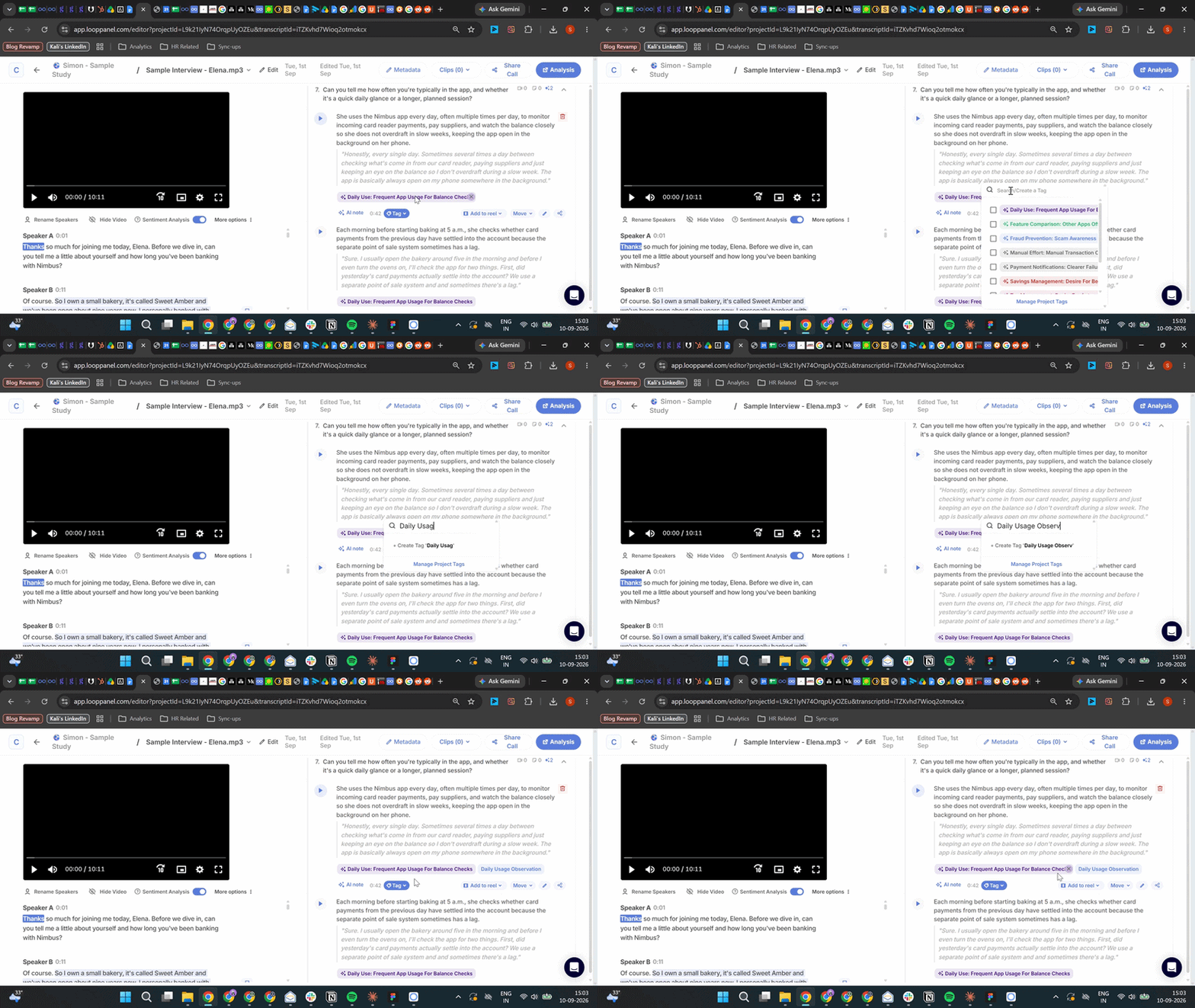
Dovetail’s model is more binary: you either commit to its manual taxonomy system, tagging everything by hand, or you rely on its “Magic AI” features that give black boxes a run for their money. It’s one or the other, never both at once. A user on Reddit said that their tags were “hot garbage” (their words, not ours).

Repository search
This is Dovetail’s biggest, most consistent complaint across independent sources:

The root problem is dependency: Dovetail’s search relies heavily on manual tagging. This means you have to predict every possibility how someone might search for a piece of feedback later, like this:

Get the tags wrong and you lose the insight to The Void…forever.
Looppanel takes a different approach: the AI organizes your content thematically as soon as it’s uploaded, so search works even before anyone has tagged anything. Plus, editability lets you refine your organization afterwards, i.e., you find what you need today and clean up the structure as you go.
Click here to learn more about Looppanel’s Smart Search feature.
Transcription accuracy
Transcription is genuinely hard to get right at scale: with accents, overlapping speakers, and niche terminology tripping up every AI transcription to some degree.
While Dovetail supports a wide range of languages and gets genuinely strong reviews on accuracy, it still falls short when acronyms and industry jargon are present in the transcript.
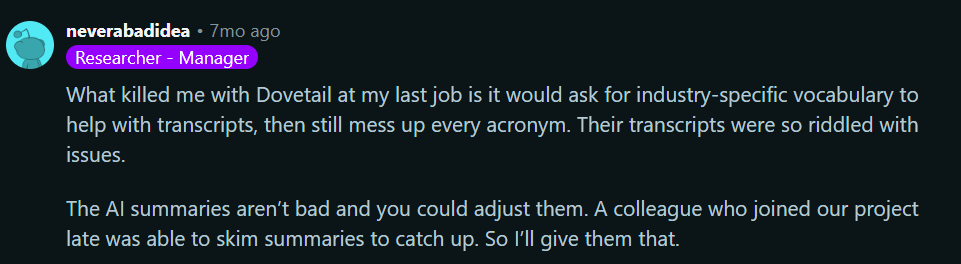
Looppanel’s transcription accuracy is a little better compared to Dovetail. A reviewer mentioned that she didn’t even have to clean up the auto-generated MS Teams transcripts before running analysis on them:

Bottom line: transcription accuracy varies by use case for both tools, so take any specific accuracy percentage that you see with a grain of salt.
Reels & sharing
This is a close tie: Dovetail users repeatedly call its reel-building “essential” for turning raw interviews into stakeholder-ready highlight videos. Looppanel users say the same about shareable clips and snippets: multiple reviewers specifically called out how easy it is to get a stakeholder to actually watch a piece of feedback instead of reading a summary.
One thing to verify as you evaluate: Dovetail’s canvas/reporting format has drawn some criticism for being clunky compared to a tool like Miro. If you prefer polished, presentation-ready reporting, you should test both tools live.
Collaboration
This is where the cracks of being a “customer intelligence platform” start to show.
Dovetail pulls everyone into the collaboration net—sales, CX, marketing, support—via Channels 2.0 and an expanding MCP connector list into tools like Salesforce and Canva. If you want a single surface for the entire company’s customer feedback, it’s a real, legitimate use case.
Looppanel’s collaboration net is narrower on purpose: we’re built around the tools UX researchers and product managers live in day-to-day: Jira, Confluence, Notion, Zendesk, and Slack. And, our Pro plan offers unlimited viewer seats, so that you can loop in another stakeholder without paying another extra dime.
Dovetail’s per-seat pricing model is one of the most common complaints, as seen in their own reviews. If you want to keep adding viewers without the additional buck, you gotta weigh your options carefully here.
MCP
For a while, this was a clean point in Dovetail’s favor: the 2026 push into MCP connectors (Canva, Salesforce, Hex, Notion, Linear) gave it a real integration edge. But that gap has closed now: Looppanel has shipped its own MCP.
While Dovetail’s MCP push is bundled into a broader “Agents” platform, Looppanel’s MCP is tightly scoped to research data access. However, both tools now have a credible MCP story, and you can pick based on the specific connectors your stack actually needs.
AI features beyond tagging
Dovetail has shipped an ambitious set of new AI capabilities recently: always-on Agents, “Digital Twins” built from real customer data, Channels 2.0 for surfacing product ideas automatically, and a governance suite (ISO 420001 certification, AI redaction, custom data retention).
These are fairly new, but this goes to show you where Dovetail’s resources are going—and it’s now toward the research-specific workflow gaps their own users have been asking them to fix for years.
Panel management
This is the clearest signal of where things are headed.
Dovetail used to have a participant recruitment feature called Recruit: connecting researchers with over 3 million verified participants and allowing them to define their audience, screen candidates, and schedule sessions.
But they sunset it as of October 2025. In their own words, they’re “shifting investment towards expanding data ingestion capabilities”, i.e., recruiting research participants isn’t where the company is putting its resources anymore.
In case you had an active study using Recruit, you can wrap it up. You can’t start a new one. And, this isn’t a mere speculation. Dovetail has written this, confirming that it built a tool for UX researchers and then discontinued it to fund a different vision of the product.
Looppanel is moving the opposite way, building panel management in, because it’s not a minor feature gap anymore. If recruiting and managing research participants is part of your job, this is a direct signal about which company still sees you as the primary customer.
P.S. Hey human! If you’re looking for a Dovetail alternative, we offer white-glove migration support from Dovetail. And that makes your switching cost…(clacking calculator keys)...zero.
Click here to let us know if you’re considering the switch to Looppanel
Pricing
Dovetail runs a free tier (1 project, 1 channel) and an Enterprise tier that requires a sales conversation to know the pricing. However, G2 reviewers consistently flag Enterprise pricing as steep and unpredictable.
Looppanel keeps it simple: a Solo plan at $49/month, a Pro plan at $395/month (with unlimited viewers included as collaborators), and an Enterprise plan with custom pricing.
Pros and Cons of Dovetail & Looppanel
Why Dovetail customers are switching to Looppanel

Here's what it comes down to:
One flow, not two modes
One reviewer said, “Looppanel is not as cumbersome as Dovetail and has one simple flow that can be easily followed to generate insights.” Whether you’re doing manual tagging or trusting the AI: it’s one continuous workflow either way.
Simple pricing
Solo at $49/month, Pro at $395/month with unlimited viewer collaborators, and a custom Enterprise quote—that's the whole story. We have zero incidents of the "costs absolutely ballooning in a year" kind.
Faster to get moving
Dovetail’s reviewers flag a steep learning curve and a lack of onboarding guidance. Looppanel reviewers consistently describe close-to-zero setup friction: you’re tagging and analyzing insights on day one.
No feature gaps
Looppanel shipped its own MCP this year, closing what used to be a real Dovetail advantage. And, on panel management, the story has actually flipped: Dovetail retired its participant recruitment feature, while Looppanel is investing in exactly that.
So, which one should you actually pick?
If you’re a UX researcher, PM, or a small research team that wants a tool built around your workflow—one that helps you build tags without demanding a perfect taxonomy upfront, doesn’t charge you each time you bring in another stakeholder, and is easy to use from day one—choose Looppanel.
However, if your organization genuinely wants one platform serving sales, CX, marketing, and research, and has the Enterprise budget for it: Dovetail’s breadth is real and worth considering.
Looking for other options beyond these two? Check out our full breakdown of Dovetail alternatives for a wider list.
Your peers also ask
Is Dovetail still good for UX research?
It still has real strengths. But its product reviews (unreliable search, clunky UI, tagging complexities) and product decisions (like retiring participant recruitment) suggest UX research is no longer its sole focus.
What is Looppanel's pricing?
Looppanel offers a Solo plan at $49/month, a Pro plan at $395/month (with unlimited viewer seats), and a custom Enterprise pricing. Check our pricing page for current details.
Does Looppanel have MCP support?
Yes, Looppanel has MCP support in beta version.
Why did Dovetail discontinue Recruit?
Per Dovetail's own documentation, it's reallocating investment toward "data ingestion capabilities" as part of its shift toward being a broader customer intelligence platform, rather than a UX-research-first tool.
What are the real alternatives to Dovetail?
Beyond Looppanel, Condens and Marvin come up most often in community discussions as tools researchers have actually switched to.




.svg)


