
Participant screenerbuilder
Participant screener builder is a free Claude skill from Looppanel that writes screeners to find people who actually do the thing you're studying. Questions are neutral and hard to game, with eligibility, quotas and review rules kept separate.


What it does
It asks about recent, concrete behavior instead of self-ratings, and never widens your target population on its own. Quotas only go in once you confirm them. Anything else worth knowing gets collected as useful variation, not enforced.
Use it when
- you're about to recruit and need the screener today
- your last study pulled in professional survey-takers
- you're unsure what's a must-have and what's nice to have
Not for
- inventing quotas or incentive amounts
- letting adjacent roles in when you didn't ask
- running the recruit itself
Works on
- Research brief
- Target profile
- Existing screener
Paste an old screener and it'll audit it.
How it works
A brief for UX researchers, turned into a screener that doesn't let PMs slip through.
Input
“Build a screener for this study.”

Try it
Prompts that trigger it
Say any of these once the skill is added. Your AI picks the method up on its own.
1
“Write a screener for this study.”
Copy
2
“Audit this screener for leading questions.”
Copy
3
“Who should qualify for these interviews?”
Copy
Pairs well with
Skills people run before or after this one.


Frequently Asked Questions
How do I write a UX research brief with AI?
Install Looppanel's free Study brief builder skill in Claude and ask it to turn your question into a research brief. It returns the decision to inform, objectives, a recommended method with its limits, a participant strategy, risks, and the inputs you still need to confirm.
How do I write a discussion guide for user interviews?
Start from your research objectives and participant profile. Looppanel's free Discussion guide generator skill turns those into a timed guide with an intro, warm-up, core topics, probes and wrap-up. It rewrites leading, yes/no and hypothetical questions before you see them.
How do I write a screener that's hard to game?
Ask about recent, concrete things people have personally done, not how they rate themselves, and don't make the qualifying answer obvious. Looppanel's free Participant screener builder skill writes questions this way and marks which answers qualify, disqualify or need a researcher's review.
How do I write unbiased survey questions?
Ask about the problem before the solution, use frequency scales for behavior, and avoid leading, double-barreled and hypothetical questions. Looppanel's free Survey builder skill checks every question for these problems before returning the survey, and tells you which ones it changed.
What is an unmoderated usability test?
It's a study participants complete on their own, with no moderator present. They work through tasks on a prototype, live site or set of screens while their behavior and answers are recorded. It works best for task completion, navigation, first-click, tree tests, card sorts and comprehension.
What do I need before launching a user interview study?
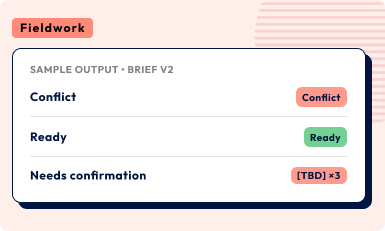
An approved brief, a screener, a discussion guide that fits the session length, and decisions on consent, recording, incentives and scheduling. Looppanel's free Interview study setup skill checks these against each other and gives you a Ready list and a Needs confirmation list.
How do I code qualitative research data with AI?
Give Looppanel's free Evidence coder skill your notes, quotes or open-text answers, plus your tag set if you have one. It splits them into single-idea evidence units, applies tags with definitions and include/exclude rules, and keeps every quote word for word with its source.
How do I make an affinity map with AI?
Give Looppanel's free Affinity map builder skill your notes, quotes or highlights with participant IDs. It groups the evidence bottom-up into clusters and higher-level groups, explains why each cluster holds together, and lists how many sources sit behind it.
How do I synthesize user interviews with AI?
Give Looppanel's free Findings builder skill your transcripts, highlights or tagged evidence. It moves from evidence to pattern to finding to implication. Each finding comes with a confidence level, how many participants support it, and the counterevidence against it.
How do I present UX research findings to stakeholders?
Lead with the decision the research informs, then show three to five takeaways, each with how many participants back it and why it matters. Keep quotes visible as quotes, and say what you still don't know. Looppanel's free Stakeholder shareout skill builds readouts in this shape.
How do I use user research in design decisions?
Before designing, write down who the users are, what they fear most, the nouns they use, and where the research is silent. Looppanel's free Research-informed design skill does this from your research first, then checks the design against nine common structural mistakes.
What are synthetic users in UX research?
Synthetic users are AI personas that react to a design the way a type of real user might. Looppanel's free Synthetic user review skill only builds them from real research, splits them on what each group fears, and has each one review the design independently.
Does the Study brief builder make up details?
No. Owners, dates, incentives and recruitment channels it doesn't know come back as [TBD]. It keeps what you told it separate from its own inferences and recommendations, and only asks a question when a missing input would change the study design.
How many topics fit in a 60-minute user interview?
About three to four core topics. A typical split is 5 minutes for the intro, 5 for warm-up, 40 to 45 for core topics and 5 for wrap-up. If your topics won't fit, the Discussion guide generator flags what to cut or make optional.
What's the difference between eligibility, useful variation and quotas?
Eligibility decides who can take part. Useful variation is worth recording but doesn't decide anything. A quota is a sample target you deliberately enforce. The Participant screener builder keeps these separate, so interesting variation doesn't quietly turn into a quota.
How many questions should a post-interview survey have?
Fewer than eight. You already have depth from the interviews, so the survey only needs to measure how common and how severe each theme is. The Survey builder states your top interview themes as hypotheses and tests each one, using participants' own words.
When shouldn't I run an unmoderated study?
Skip it for exploratory discovery that needs live follow-up questions, sensitive topics that need rapport, or concepts with no stimulus to react to. Looppanel's free Unmoderated study generator checks this fit first, and recommends a better method when unmoderated is the wrong one.
Does Interview study setup schedule sessions or send invites?
No. It plans the fieldwork but doesn't book anything or contact participants. It doesn't assume any particular scheduling tool, incentive provider or research platform, and anything your team hasn't decided stays marked [TBD].
What's the difference between note count and participant count?
Note count is how many highlights mention something. Participant count is how many different people said it. One talkative participant can produce ten notes. The Evidence coder reports both for every tag and never treats note count as how common something is.
Is an affinity map cluster the same as a research finding?
No. A cluster organizes evidence, while a finding is a claim about what the evidence means. The Affinity map builder ends every map with what it doesn't establish yet, then hands off to a synthesis step like Findings builder.
How do I know which findings to trust?
Look at breadth and counterevidence, not how often something came up. The Findings builder shows how many distinct participants back each finding, lists evidence that cuts against it, and flags thin signals, like two participants from the same account, as not yet a finding.
Will it make my findings sound stronger than they are?
No. Stakeholder shareout is a communication layer, not a second synthesis. It changes emphasis and depth for each audience but never what the research established, and a shorter headline is never allowed to sound more certain than the finding.
What if I don't have any research?
Research-informed design still works, but it tells you plainly that every decision is its own judgement, not your users', and marks each one that way. It never presents an assumption as a finding.
Can synthetic users replace real user research?
No. Synthetic user review produces hypotheses, not evidence. Don't use it to settle a decision, to speak for people your research didn't cover, or to skip recruiting. If there's no research behind it, the skill stops rather than invent a persona.
What's the difference between a research brief and a discussion guide?
A research brief decides what the study needs to learn and which method to use. A discussion guide is the list of questions for each session. Use Study brief builder first, then Discussion guide generator to turn the brief's objectives into interview questions.
What is a Looppanel-ready discussion guide?
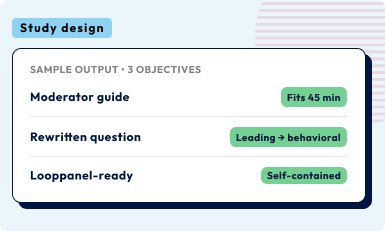
It's a second version of your guide where every question makes sense on its own, without section headings, timing or moderator notes. Looppanel uses guide questions to organize interview notes, so self-contained questions keep those notes readable.
Will the screener builder add quotas or roles I didn't ask for?
No. It never widens your target population, so a study for UX researchers won't let in PMs or designers. Quotas it thinks are worth adding come back as optional and stay out of the qualification logic until you confirm them.
What kinds of surveys can the Survey builder make?
Four types: feature validation, concept testing, NPS or CSAT, and post-interview follow-ups. Each one follows the same skeleton: a context question, a behavioral anchor, three to seven core questions and an open-ended closer.
Do I need a research platform connected to use it?
No. The Unmoderated study generator produces a complete study design on its own: tasks, scenarios, measures and a participant flow. It labels the study as needing input, designed but not field-ready, or field-ready, so you know what's left before launch.
What if my brief, screener and guide disagree?
Interview study setup flags the conflict, for example a brief that says 45-minute sessions and a guide timed for 60. It follows your latest instructions and tells you which artifact it treated as the source of truth.
Can it clean up an existing tag taxonomy?
Yes. In audit mode, the Evidence coder looks for duplicate tags, tags too broad or too narrow to be useful, inconsistent application and unsupported sentiment. It proposes merges, splits and renames rather than making the changes silently.
What happens to notes that don't fit any cluster?
They stay on the map. The Affinity map builder keeps outliers, emerging clusters and contradicting evidence visible, marked as held in tension, instead of forcing them into the nearest group or dropping them.
Can the Findings builder synthesize across several studies?
Yes, it handles single-study and cross-study synthesis while keeping track of where each piece of evidence came from. If you only have earlier summaries instead of raw evidence, it says it's synthesizing a synthesis and lowers its confidence.
Can I make different versions for leadership and product?
Yes. Tell Stakeholder shareout the audience, such as leadership, product, design, engineering or GTM, and it reshapes the narrative and level of detail for them. The findings, confidence levels and caveats stay the same in every version.
When does it stop and ask instead of deciding?
When a decision would expose one person's data to someone else, can't be undone or applies retroactively, depends on legal, regional or language context, or contradicts something the research says directly. In those cases it flags the decision for a person to make.
How do I know if synthetic personas are accurate?
Hold out one distinctive participant, rebuild the personas from the rest in a fresh session, and check whether they predict that participant's real concerns. Synthetic user review walks through this test and reports the miss rate, not just the hits.

.svg)


