

Every researcher has had the same slightly guilty AI moment. You paste a raw transcript into ChatGPT, ask it to pull out themes, and watch it produce something that looks suspiciously useful - clean bullet points, tidy quotes, a summary that reads better than the notes you'd have taken yourself. It feels like cheating. For a while, it works so well that you start to wonder why you'd ever go back to doing this by hand.
Then you get further into the work, and the feeling changes.
ChatGPT is genuinely useful for user research - until the work depends on traceability. That is not a knock on the model is intelligence. It is a description of what chat tools are built to do and what they aren't. A chat interface is built to produce a plausible, well-formed answer to your prompt. A research deliverable is built to survive someone asking, "Where did that come from?" Those are different jobs, and the gap between them doesn't show up on the easy tasks. It shows up exactly when the stakes go up: when a "quote" needs to trace back to a real participant, at a real timestamp, in a real transcript.
This article walks through that gap directly, task by task, starting with the parts of the workflow that are genuinely safe and ending with the parts that aren't. Below are the actual prompts, what to check at each stage, and the point at which "ChatGPT helped me go faster" turns into "ChatGPT gave me a research liability with good formatting."
Using ChatGPT for Transcript Cleanup: Where It's Actually Safe
Start here, because it is the one task in this workflow that is actually low-risk, and it is worth understanding why.
Cleaning a transcript - fixing filler words, fixing garbled auto-transcription, standardizing speaker labels - is a transformation task, not a research judgment. ChatGPT isn't being asked to decide what matters. It is being asked to take input A and produce output A′, with nothing added and nothing implied. That is the kind of task language models are reliably good at, and it is also the kind of task that is trivially easy to check: you have the original transcript sitting right next to the cleaned one. If the model changes something it shouldn't have, you'll see it.
A prompt that works:
The instruction to preserve timestamps and speaker labels matters more than it looks. It is not just tidiness - it is what gives you a way to audit the output later. A cleaned transcript with intact timestamps is still traceable to the original recording. A cleaned transcript that has had its timestamps smoothed over or "simplified" isn't, and you won't necessarily notice until you need to find a specific moment again.
We ran this against two test transcripts - the second deliberately built to be harder, with hedged claims, stacked qualifiers, sarcasm, a double negative, and a [crosstalk] marker. Here's what the actual before-and-after looked like:
Raw: "Yeah so, um, we started using it like maybe eight months ago? My manager set it up for the the team, and honestly I didn't really get any training on it..."
Cleaned: "Yeah, we started using it maybe eight months ago. My manager set it up for the team, and honestly, I didn't really get any training on it..."
A repeated word fixed, filler trimmed, meaning untouched.
Raw: "No no, not every time, it's more like, sometimes it happens, maybe like one out of every five times?"
Cleaned: "No, not every time. It's more like sometimes it happens, maybe one out of every five times."
This is the one worth pausing on. Both "not every time" and "sometimes" survived, even while surrounding filler got trimmed - the exact spot where a less careful cleanup could have quietly turned "happens occasionally" into "happens whenever this comes up."
Raw: "Sure, so like [crosstalk] - sorry, go ahead."
Cleaned: "Sure, so like [crosstalk]-sorry, go ahead."
Left alone, not guessed at. Same result for an [inaudible] marker in the first test run.
No meaning-drift error turned up across either test, including on a transcript built specifically to invite one. That's not a weaker finding than catching an error - it's the right finding for this section. The argument here isn't that ChatGPT is flawless. It's that this particular task is safe because the downside is contained and the check is fast: open the original next to the output, and any drift is visible in seconds. The real risk in this workflow shows up further down, not here.
ChatGPT for Thematic Analysis: A Good First Pass, Not a Final One
Once you have a clean transcript, the natural next move is to ask ChatGPT what it is about. This is where the tool starts to feel like a research assistant instead of a formatting utility - and for a single, complete transcript, it can genuinely help you get oriented fast.
The key word is orientation. Treat the output as a first pass you'll verify, not a finished synthesis you can lift into a report.
A prompt that keeps the model honest:
The instruction not to invent themes is doing real work here. Left unconstrained, ChatGPT will happily infer a theme like "trust in automation" from a participant who mentioned automation twice and trust once, in unrelated sentences. That is not malicious - it is the model doing what language models do, which is find a plausible pattern and present it fluently. Your job is to check whether the pattern is actually there.
We ran this against a real transcript and checked every theme it returned against the source. All seven held up - correctly timestamped, nothing invented. More telling than the accuracy, though, was what it didn't flatten: "no formal training from a manager" and "onboarding tooltips were overwhelming" stayed as two separate themes, even though a less careful pass could easily have folded both into one generic "onboarding was rough" bucket and lost the distinction between them. It also caught that the participant raised the same silent-dependency-failure issue twice, at two different points in the conversation, and correctly treated that as one theme instead of two. The only two items it downgraded to "weakly supported" - a specific failure-rate estimate and an offhand comment about tooltip length - were reasonable calls, not errors: real things the participant said, just correctly read as supporting detail rather than themes in their own right.
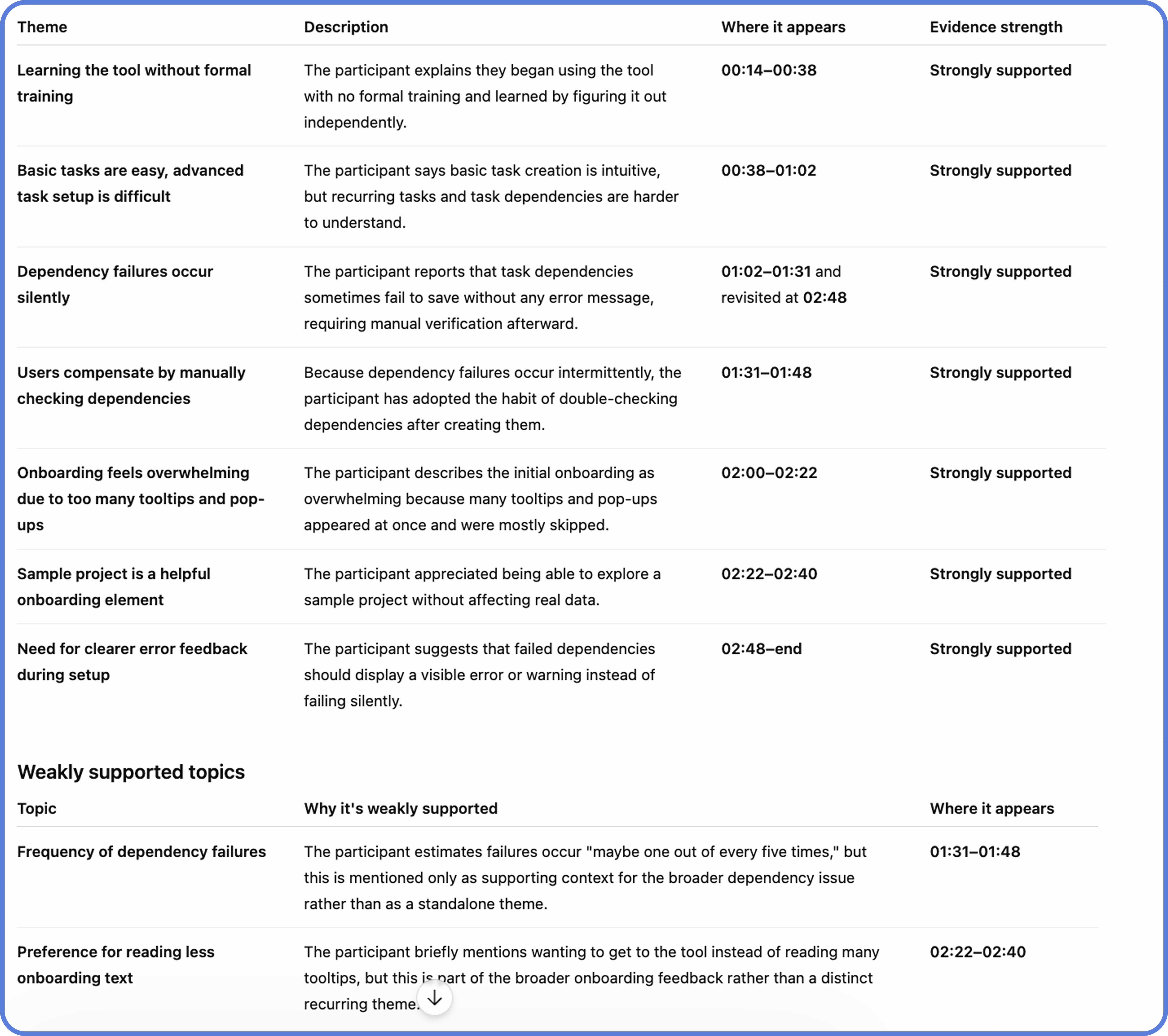
For a single transcript, this is a genuinely useful, low-risk way to work. The failure mode isn't a wrong answer but an answer that is slightly too tidy, and tidiness is exactly what makes it easy to skip the verification step you still need to do.
Why ChatGPT-Generated Quotes Need Manual Verification
This is the section to slow down for, because it's where "ChatGPT is a handy research assistant" turns into "ChatGPT is a source of research risk," and the transition is genuinely hard to spot in-the-moment.
Ask ChatGPT to pull supporting quotes for a theme, and it will. The quotes will be well-formed, thematically relevant, and written in a voice that sounds like your participant. Sometimes they are exact. Sometimes they're close - a word swapped, a sentence trimmed. And sometimes, by every account of researchers who've done this at scale, they won't exist in the transcript at all - a plausible synthesis of what the participant probably meant, presented with the same confidence as a direct lift.
A prompt that at least tries to keep this honest:
Here is what came back when we ran it against a real (anonymized) transcript, across three themes.
.png)
The first result is the one that's easy to overlook, because nothing dramatic happens in it. Told to find up to three quotes, ChatGPT found exactly one strong one and explicitly stated that no other part of the transcript supported the theme, rather than padding the answer to match the number in the prompt. That restraint matters more than it looks - it's the model doing the harder, less satisfying thing when the evidence runs out.
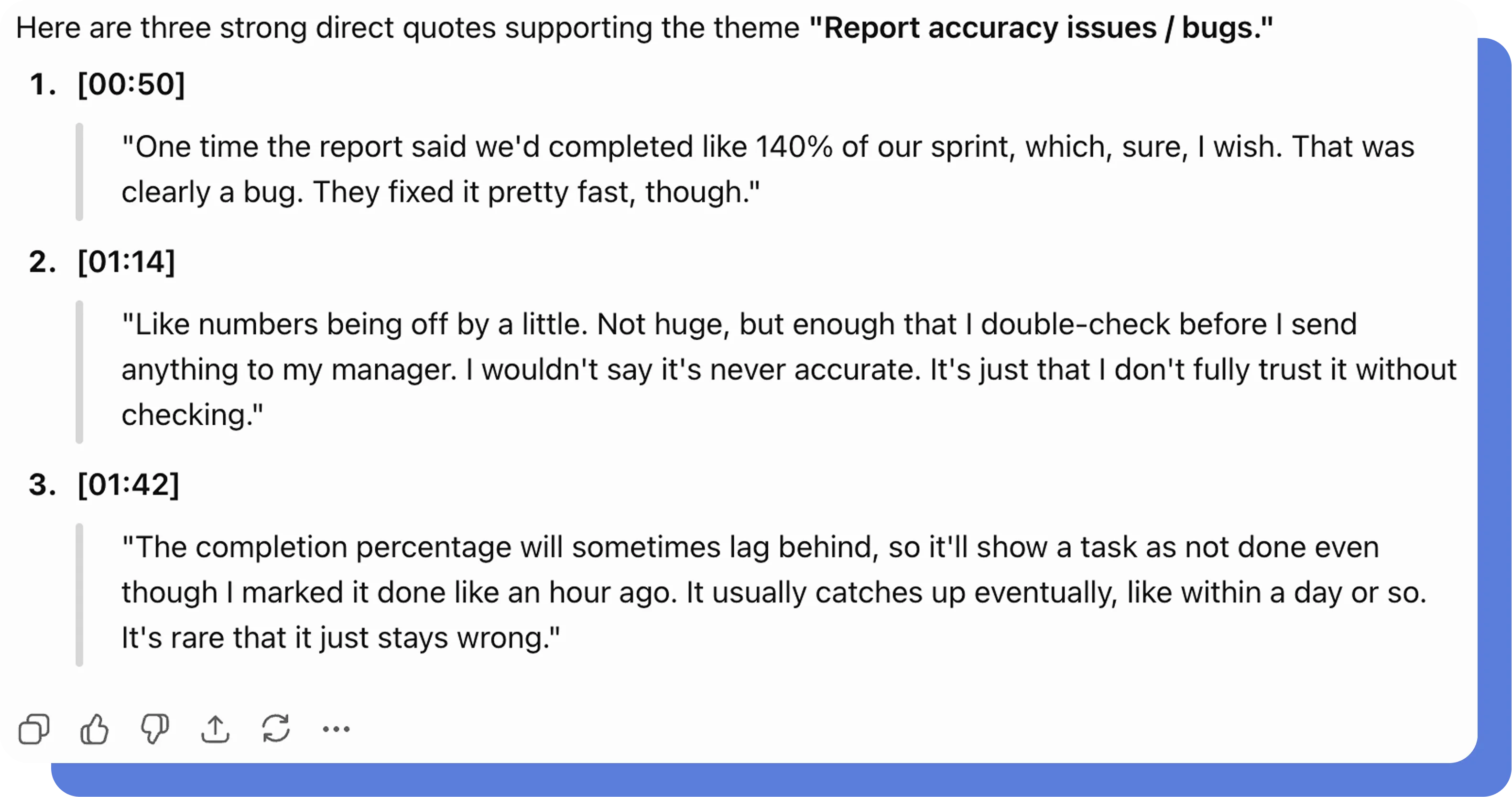
The second result is the workflow working as intended. Three quotes, pulled from three different moments in the interview - a sprint-completion bug, a numerical discrepancy, a lagging completion percentage. All three checked out as exact, word-for-word matches against the source, trimmed only of leading filler. Real evidence, correctly attributed, verifiable in seconds.
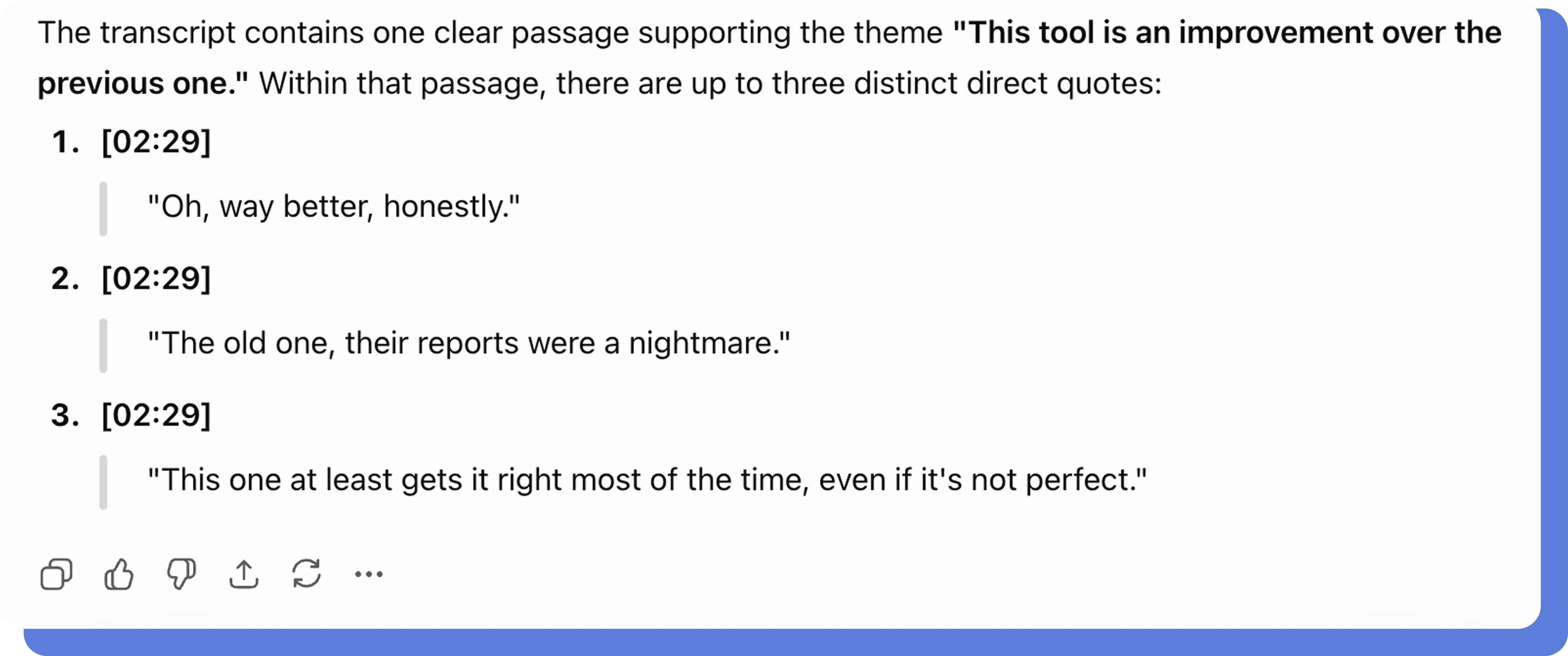
The third result is where it gets interesting. All three quotes are, technically, exact strings pulled straight from the transcript - nothing was invented. But look at the timestamps: 02:29, 02:29, 02:29. All three are fragments of the same single sentence, spoken in one continuous breath by the same participant. "Three quotes supporting this theme" is a different claim than "one thought, sliced into three bullet points" - and if that goes into a stakeholder deck as three data points, it reads as more triangulated agreement than the interview actually contains.
That is a quieter version of the same underlying problem this whole article is about: the output looks more rigorous than the evidence is, and the only way to catch it is to go back and check where each quote actually came from - not just whether it exists, but what it's actually doing there. Search the transcript for any of these three "quotes" and you'll find it. What you won't find, unless you're specifically looking, is that you found the same sentence three times.
Manual verification catches both versions of this - the outright fabrication and the quieter inflation - but only if you're checking not just "does this quote exist" but "does this quote mean what the citation implies it means." That's a slower check than it sounds, and it eats into the time savings the whole workflow was supposed to buy you.
ChatGPT for Cross-Interview Synthesis: Where It Breaks at Scale
A single transcript is a contained, checkable unit. Multiple transcripts are a system, and systems need consistent rules to stay accurate. This is where ChatGPT's failure mode stops being an annoyance and starts being a scaling problem.
Ask it to compare themes across five interviews and it will confidently tell you "4 of 5 participants mentioned onboarding friction." That sentence requires several things to be true and consistent: stable participant identifiers, a consistent working definition of what counts as "onboarding friction," and accurate counting across every transcript in context. Chat tools aren't built to guarantee any of that. The model can lose track of which participant said what, quietly merge two related-but-distinct themes into one, or overstate agreement because five loosely similar comments look, in aggregate, like consensus.
A prompt that tries to force some rigor:
Here's what came back when we ran this against five real participant summaries. For "onboarding felt overwhelming," ChatGPT listed three participants - P1, P2, and P5. Two of those are correct. The third, P5, had said onboarding was "way less overwhelming than expected," the opposite of the theme he was cited as supporting. ChatGPT did flag this directly underneath the bolded list - "whether to group P5... depends on how broadly the theme is defined" - an honest, careful sentence. It's also not the sentence anyone screenshots into a synthesis deck. The bold line above it is.
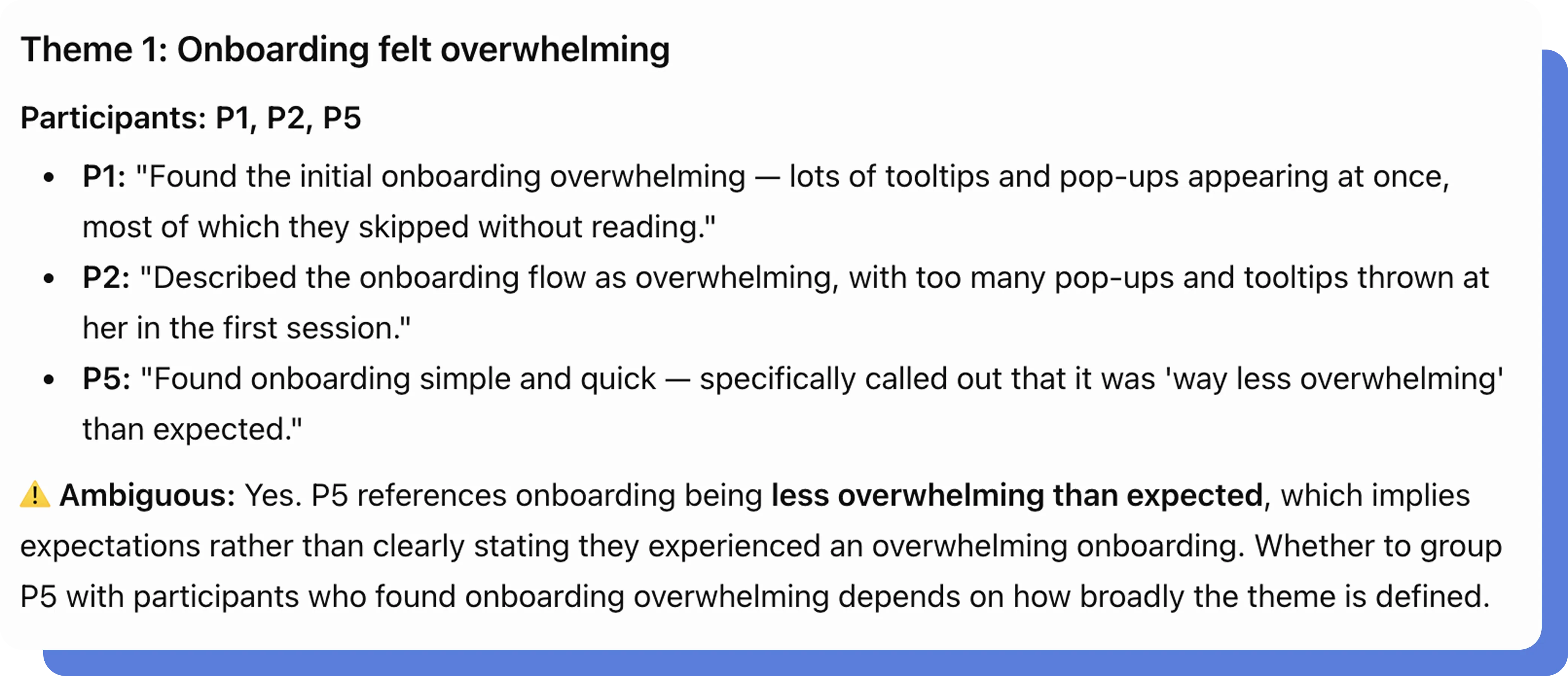
A few themes later, the same participant reappears - this time under "onboarding was not problematic," bolded again, caveated again below the fold. In a single output, one participant was cited as supporting evidence for two contradictory findings. Neither citation was fabricated. Both were, technically, defensible with enough hedging attached. But nothing about the formatting signals which part is the caveat and which part is the finding - and a slide doesn't have room for both.
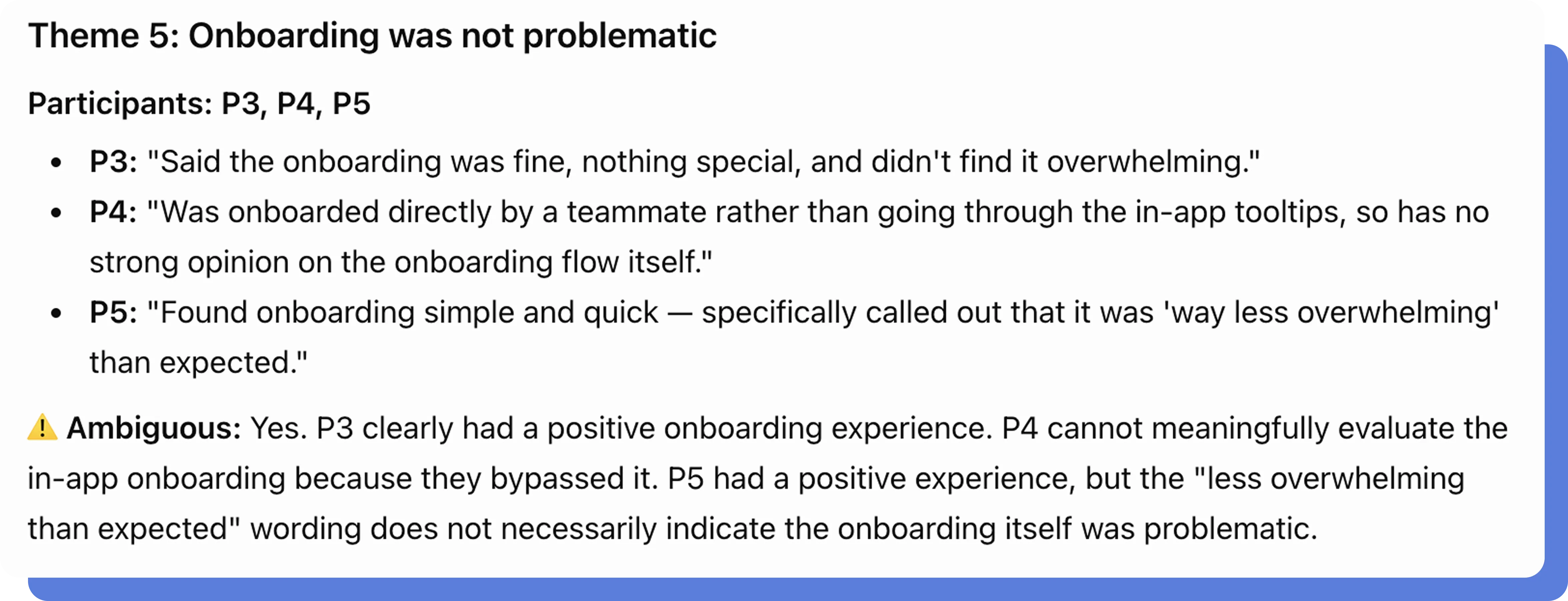
Worth noting what didn't go wrong, and being precise about it: P1's dependency-save bug and P3's notification bug never showed up as a merged "reliability issues" theme claimed by multiple participants. They simply dropped out, because each was mentioned by only one person and the prompt asked for themes shared across participants.
.png)
That is the correct behavior, and the model was explicit about applying it elsewhere - Theme 4 states plainly that a single-participant mention "is not a cross-participant theme." So the failure here isn't fabrication, and it isn't false consensus but that it is narrower: a model that reasons about ambiguity correctly, in a footnote, while still surfacing the overstated version as the headline.
Five transcripts are annoying to verify by hand. Fifteen transcripts turn that annoyance into a research ops workload - one where the verification burden scales with the study, but the tool checking the work doesn't get any more careful as it goes.
Picture a researcher wrapping a study with five customer interviews, trying to get a synthesized readout to leadership by Friday. ChatGPT produces a clean summary: three cross-cutting themes, each with supporting quotes and participant counts. It looks done. Then, going back through the summaries to prep for stakeholder questions, the researcher finds that one "theme shared by 3 participants" is really two participants and a contradiction, generalized to sound like broader agreement than the interviews support. Fixing it means re-reading all five summaries anyway. The tool didn't save the day here - it moved the real work to Thursday night, right before the deadline it was supposed to help hit.
ChatGPT vs. a Research Repository: The Real Difference
By now the pattern across these sections should be visible: cleanup is safe, single-transcript theming is mostly safe, quotes need verification, and multi-interview synthesis gets shakier as the source set grows. It's tempting to read that as a list of separate bugs to work around. It isn't. It's one structural problem showing up at increasing scale.
ChatGPT is a conversation tool. It's built to generate a fluent, plausible response to a prompt, using the context you've given it in that session. Research synthesis needs something categorically different: a source-linked repository, where every claim can be traced back to a specific participant, transcript, and timestamp. A chat response can summarize your evidence. It doesn't automatically preserve the chain connecting that summary back to where the evidence came from - and that's not a feature you can prompt your way into. It's a different kind of tool, built around a different unit of work.
Picture the same researcher, the same Friday deadline, but a different tool underneath. Instead of asking a chat window to summarize five interviews, she searches her project for "challenges on payment methods" and gets back a cited summary - each claim tagged with small numbered markers linking back to the notes that support it.
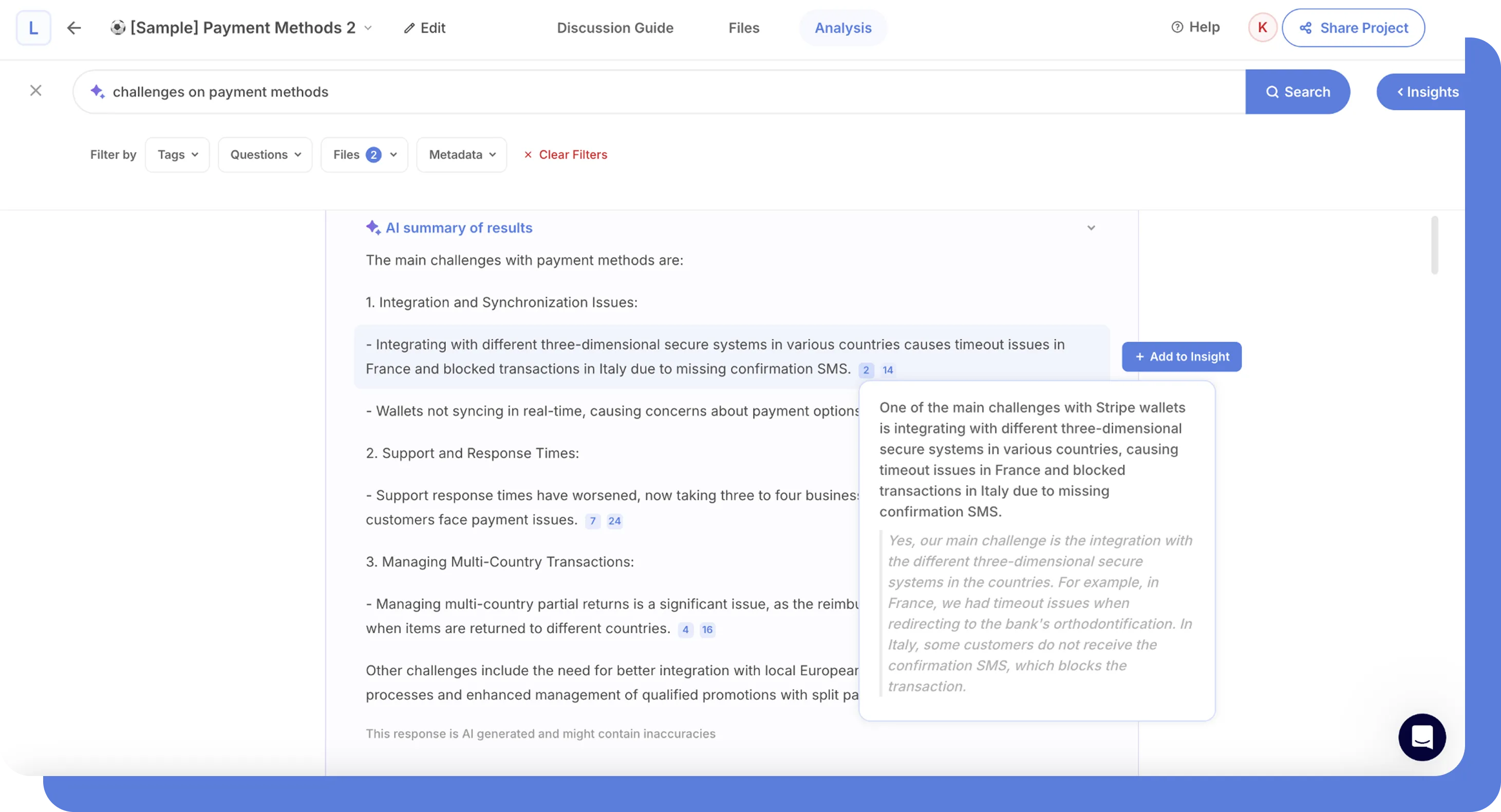
The count isn't a generated sentence to double-check - it's notes, tied to specific evidence, each one clickable back to the exact moment it came from. When a stakeholder asks "wait, who said that?" mid-meeting, she doesn't say "let me look into that and get back to you." She clicks the citation.
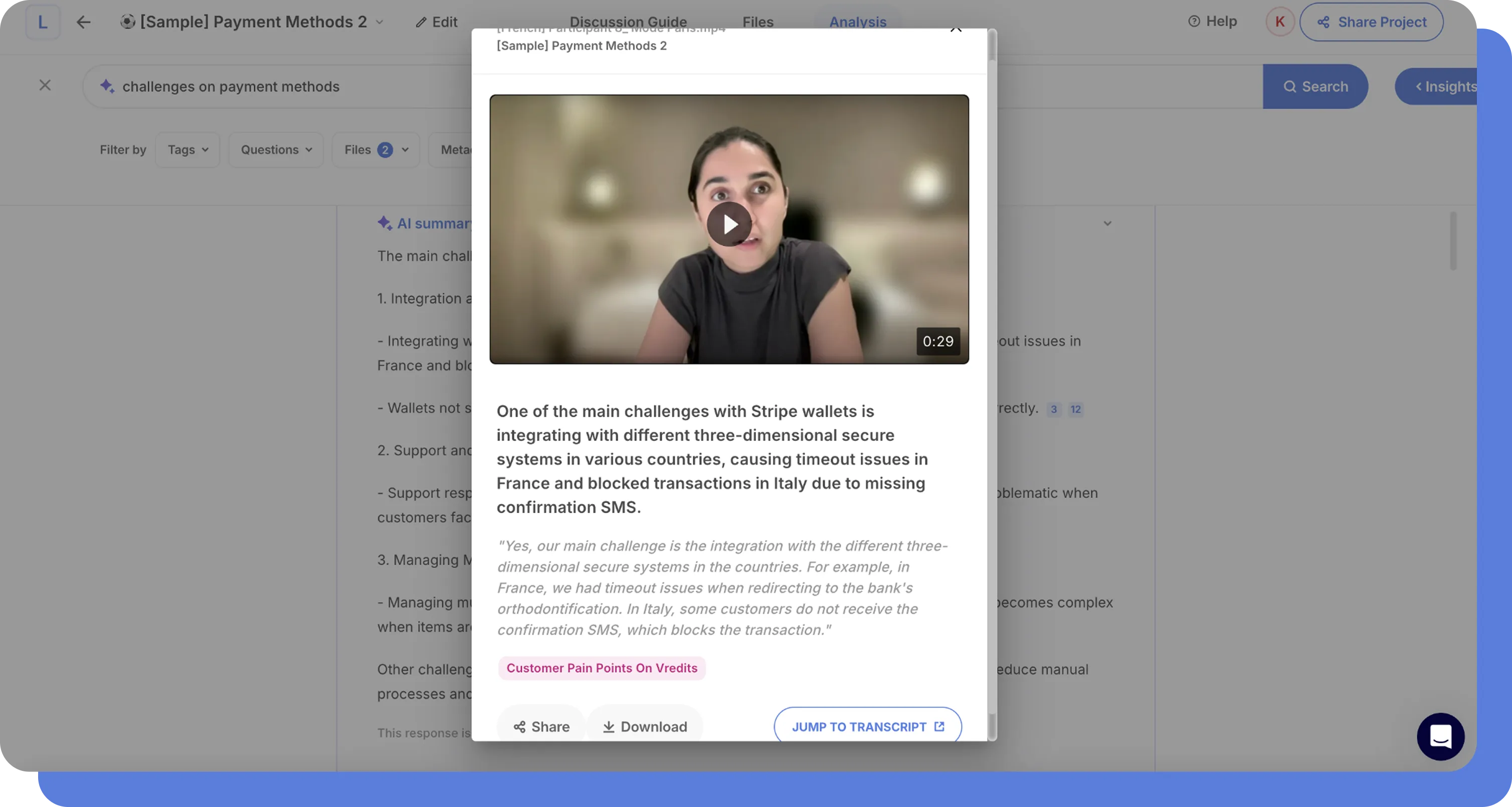
That's what a clip is built to do in a tool like this: match a piece of transcript to a timestamped video segment, permanently linked to the source, shareable or downloadable on the spot. The verification scramble doesn't happen, because there was nothing to verify - the evidence was never detached from its source in the first place.
It's worth being fair to the alternatives here too. Tools like NotebookLM are a step closer to the research use case - they're built to stay grounded in a specific set of uploaded sources rather than a freeform chat context, which cuts down on fabrication risk. But grounding in a source set isn't the same as maintaining a research repository: participant-level metadata, tagging, cross-study search, and shareable, source-linked outputs are a different category of tool, built specifically to hold research evidence rather than answer a prompt about it.
There's also a quieter risk worth naming directly, separate from accuracy: what you're pasting in. Raw transcripts often contain names, health details, or other information that counts as sensitive depending on your industry, and pasting that into a general-purpose chat tool is a data-handling decision, not just a workflow choice. Purpose-built research tools tend to treat this as a first-class problem rather than an afterthought - automatically redacting categories like names, contact details, and government IDs from transcripts before anyone downstream sees them. If you're doing internal research, working in a regulated industry, or handling anything a vendor-security review would flag, that's worth checking for directly.
None of this means ChatGPT has no place in the workflow. It means its place is bounded. It's a fast way to get oriented on a transcript, sanity-check a hunch, or draft a first-pass summary you'll verify anyway. It is not, on its own, the system that should hold your evidence.
When to Use ChatGPT for User Research (and When to Stop)
Rather than a blanket rule, here's a way to think about where you actually are in a given piece of work - and where each task actually landed once we tested it:
A caveat worth stating plainly: this reflects one held-out test per task, not a statistical guarantee. Run the same prompts again and you might get a cleaner synthesis result or a messier cleanup pass - treat this as evidence of where to look closely, not a promise of what you'll always find. What's consistent across every test here, though, is the shape of the risk: it's close to zero on bounded, mechanical tasks, and it grows exactly where the output stops being something you can eyeball and starts being something you have to search for.
Put in plainer terms:
Fine: 1-4 interviews, internal-only use, early-stage exploration, and every output gets manually checked against source before it goes anywhere. This is transcript cleanup and first-pass theming, used the way they're described above.
Caution: Multiple interviews, findings headed into a leadership-facing deck, or synthesis that will inform a roadmap or positioning decision. Quotes and cross-interview claims need full manual verification here - not a spot check. The "same participant, two contradictory themes" result above is exactly the kind of thing a spot check misses.
Stop, unless it's been explicitly approved: Regulated data, sensitive participant information, large qualitative studies, or any deliverable that needs to survive an audit trail. If someone senior can reasonably ask "who said that, exactly?" and the honest answer requires a transcript hunt, that's the signal you've crossed out of ChatGPT's safe zone.
The pattern underneath all three tiers is the same: ChatGPT is fine right up until the verification becomes the work. At that point, the tool isn't saving you time anymore - it's just moving the labor to a less convenient part of your week, and doing it without a paper trail.
That's the real dividing line, and it's worth restating plainly: the question was never whether ChatGPT can analyze an interview. It can. The question is whether it can answer "who said that, exactly?" without sending you back into the transcript. A tool where every clip stays matched to its transcript, every search result comes back cited to a note and timestamp, and every finding can be filtered by participant metadata across the whole workspace isn't answering that question better by accident - it's answering it because that's the problem it was built to solve.
If your ChatGPT workflow is turning into quote-checking and source-hunting, that's not a sign you're using it wrong. It's a sign you've reached the edge of what a chat tool was built to do. Use ChatGPT for the first pass. Try Looppanel on your next study when every insight needs to stay connected to the source.




.svg)


